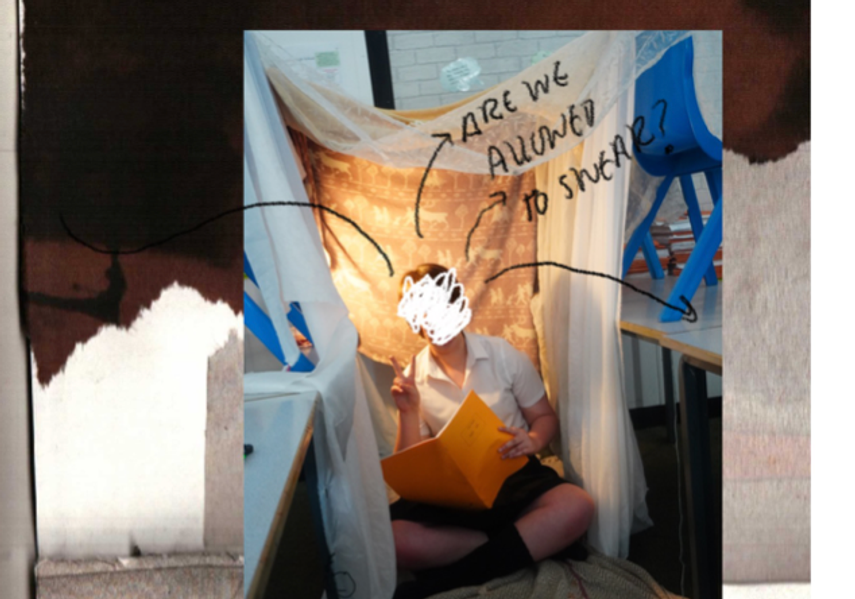
Are we allowed to swear?
Wednesday 18 November 2026
I wasn't sure what to expect when I first came to work with this group of budding young poets. Walking into the Bedford Bards, I was immediately met by passionate, nerdy, vibrant twelve- to fourteen-year-old girls, full of life, ideas and wonderfully intense special interests. This was already their safe space. My role was not to create that fromnothing, but to listen carefully, build on what was already there, and help give it more room to grow.
The Bedford Bards are part of Rhyme & Reason, a creative wellbeing programme developed by Curious Minds which explores how poetry can support and promote positive mental health and emotional wellbeing in secondary schools. The programme draws on the Arts for the Blues model, an arts-based approach originally developed as an alternative to traditional talking therapies. Rather than asking young people to explain themselves directly, Arts for the Blues creates different routes into expression through creative writing, visual art, movement and music. This is my secondyear working on the project, and my own personal philosophy in relation to my own wellbeing, neurodivergence and feminine perspective has developed alongside it.
There is something powerful about giving a young person another language when ordinary language feels too exposing. A poem can say something without having to explain everything. A collage can hold an emotion without naming it. A fictional character can carry a feeling that might be too difficult to claim as your own. The training and residential we undertook as part of Rhyme & Reason gave me a framework for thinking about this more intentionally.Alongside the Arts for the Blues training, we explored trauma-informed practice, creative evaluation and the research question at the heart of the programme. Working alongside Curious Minds, other artists and teachers made me thinkdifferently about what it means to enter a school as a creative practitioner. I wasn't simply arriving with a workshop plan and hoping the young people enjoyed it. I was being encouraged to think about the emotional journey of a group, the conditions needed for participation, and how creativity might support wellbeing as well as artistic development. I was also prepared to be constantly shifting and adapting my process to meet the individuals in the group at their level.
This was also strengthened by working in partnership with Mr Leslie who knew the rhythms of the school day and the personalities of the young people in a way I couldn't. The collaboration meant that the creative work could sit within an existing relationship of trust. Over the weeks we wrote poems, short stories and monologues, made collages and built collaborative worlds together. The activities moved between different modes of expression, and that flexibilitybecame one of the things I valued most about the Arts for the Blues approach. Not everyone wants to sit down and tell you how they feel. Sometimes you need to make something first.
I wanted to build a space where girls could be playful, creative and free from the pressures of patriarchy and school, and I learned that safety isn’t something you announce but something you build by showing up week after week. The Arts for the Blues model gave us a structure, but adapting it to what the girls needed each session changed how I think about creative health work.
Rhyme & Reason encouraged me to pay close attention to what was happening in the room. Who had spoken when they usually didn't? Who had taken a creative risk? Who had laughed? Who had stayed behind to show me something they'd made? Who seemed more comfortable in the room than they had been the week before? In this group one girl slowly gained the confidence to be able to share her work out loud. Another became much less concerned with her spelling, and more interested in expressing something truthful within her. Quieter girls began to take up more space. Ideas became more ambitious. There was a growing willingness to share strange, funny, vulnerable and completely unpolished things.

Not everyone wants to sit down and tell you how they feel. Sometimes you need to make something first.
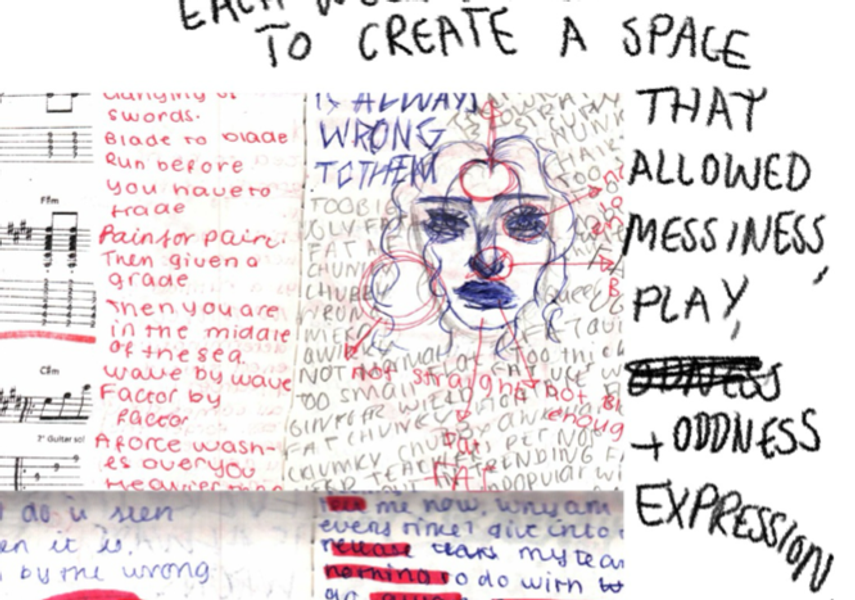
For our final session we built a small fortress, physically materialising the safe space we’d been creating. Layers of fabric and a small lamp cocooned together to form the beating heart of our fortress. But we had been building one all along. I watched as the unmasked, nerdy, weird and societally unpalatable sides of the girls came to the fore in theirwriting. I gave them home their own notebooks so they could come back to the class with scribbles, collages and personal confessions from their home lives. It was beautiful to see the mess, beauty and disorder of these pages –mapped out worlds of wild intensity and emotional discovery.
We need to build spaces where young girls are protected. Not just physically, but from the emotional wounding of humiliation and shame. Women and girls less likely to be diagnosed neurodivergent because of their ability to mask. Girls grow up with a double consciousness: they are being watched, judged constantly, and hence start watching themselves, becoming their own appointed inner critic. This means that the risks of depression, anxiety, eatingdisorders, sexual trauma and addiction is particularly high for neurodivergent young girls.
At thirteen, puberty brought depression and anxiety that have stayed with me into adulthood. I went from a bouncy, chatty child to a selective mute, hood always up, barely able to speak or get into school without a panic attack. I was under CAMHS as a teenager and soon fell into drug addiction, which several times led to psychosis. I felt disembodied and alone, and the expectations of school and friendship groups only made it worse. Without judgement-free spaces for young girls, we risk losing them to insecurity and shame.
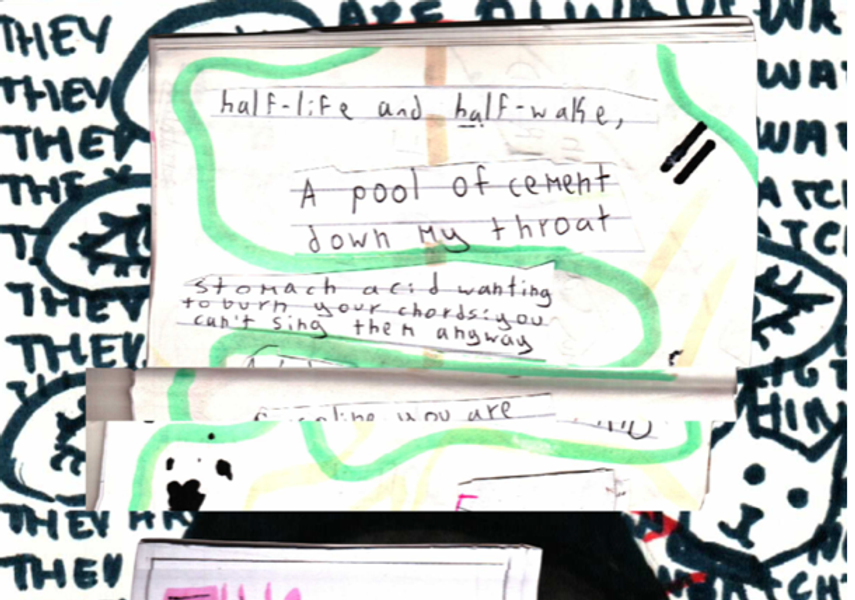
The culmination of the project became Are We Allowed to Swear?, a collection of writing and visual art by the Bedford Bards. This collection is a manifesto of sorts, and an ode to expressing yourself beyond the limits of the school system, patriarchy, neuro-normativity and the standards that attempt to box us in or flatten our voices. Despite the question in the title, these writers do not need permission. They claim agency, and ownership of their unique voices.
The book is both a record and a time capsule of a formative period in their lives. I hope it reminds them of their spark, their zeal and their love of creativity, and that they can come back to it if they ever lose sight of that. Rhyme & Reason has shown me that sometimes the most important thing we can offer young people isn’t an answer. It’s a space, a wee bit of time for connection away from a system of constant judgement and categorisation. It has also changed my own practice. I want to keep working in a slower, more reflective way, thinking about how activities can give young people different ways in, how trust is built rather than assumed, and how creative work can hold difficult feelings without needing to explain them. I want to keep making fortresses: little structures of safety where vulnerability can be held and there’s room for play, silliness and fantasy. Letting myself do things just for fun has been a big part of my own healing. Young people need spaces where they can take off the armour for a while and don’t have to brace themselves. This group has inspired me hugely, and you should watch out for all of them.