
The Curious Incident of the Artist in the Classroom
What last made you feel curious?
Thursday 30 July 2026
Did you see a poster for a new film and wonder what it could be about?
Overhear a snippet of a conversation that caught your interest?
Look up at the stars at night and wonder what it all means?
What did you do about it?
Did you look up the answer on your phone? Ask another human being? Ponder generally on the subject for a bit, then let your mind drift on to other questions?
How did it feel?
Could you not stop searching until you found the answer? Did you enjoy gathering new information? Did you find yourself distracted from the task you were meant to be doing?
Just in the course of writing these opening sentences, I found myself wondering, having just recently watched Cabaret for the first time (don't judge, please), whether Liza Minnelli won an Oscar for her performance as Sally Bowles (she did). Then whether she'd been in the stage musical (no, but apparently was rejected at audition for the original Broadway role). I quickly found myself slipping down a Wikipedia hole, before remembering what I was meant to be doing and returning to this.
Curiosity has been mused over for as long, probably, as people have been curious (haven't we always?) Curiosity has been framed as a virtue, driving scientific discovery and philosophical exploration. But it has also been seen as a vice, with too much questioning threatening the status quo – curiosity is responsible for killing the cat, of course.
The psychological study of curiosity is generally traced back to the 1950s, and the work of Daniel Berlyne, for example. Berlyne constructed a framework to help us understand the different types of curiosity we experience. Sometimes curiosity is driven by sensory stimulation, leading to humans (and, in fact, other animals) exploring novel information and experiences. You might go to the zoo and imagine how it might feel to hug a panda, for example, or smell your neighbour cooking something delicious and wonder how it tastes. Berlyne called this perceptual curiosity. Other times, curiosity is a drive to find something out, to fill a gap we know we have in our knowledge, such as my quest to find out more about the film I saw last night. This is epistemic curiosity. Berlyne also distinguished between specific curiosity, the search for a particular piece of information, and diversive curiosity, a more general exploration of a topic of interest.
Recent theories still largely relate to Berlyne's framework. Some focus on the knowledge gap - specifically the feeling of discomfort we experience until what we don't know is resolved by gathering new information. Others on the enjoyment we feel through exploring something we are interested in and want to know more about. Neuroscientific studies have shown us that feeling curious can be experienced as enjoyment in the brain: dopaminergic regions of the brain associated with reward are activated when we feel curious. Researchers have also begun to explore curiosity as a trait as well as a state. Are some people more curious, more predisposed to experience curiosity regularly? Is this true of scientists, philosophers, artists? What characteristics are shared by curious people? And what are the benefits of curiosity?
Curiosity is a drive to find something out, to fill a gap we know we have in our knowledge"
My interest in curiosity relates to education. Do schools make students curious about learning? Can children explore their own curiosities through learning in school? And what might be the benefits of pupils being supported to be more curious in the classroom? Specifically, I am interested in whether artists working with schools have any effect on how curious children and young people feel, both during sessions with artists and more generally after being involved in a project. Might working with an artist have an impact on pupils' motivation or engagement in school, their interests and activities outside of school, or their future life decisions?
Being more curious has been found to be related to positive mental health and wellbeing, self-esteem, having better memory, being more creative, and even improved academic results. Teachers have been found to support the development of curiosity in pupils through encouraging independent exploration of a topic, embracing uncertainty and the unknown, making time for questions, and sharing their own curiosities. Yet most studies have found that few schools actually do these things. Curiosity is time-intensive: giving pupils time to explore, to ask as many questions as they want, and to pursue their own interests would all be at the expense of covering the core curriculum, which most teachers feel they barely have enough time for anyway. While there are models for education, such as the Reggio Emilia approach, which are completely driven by children's curiosity, these tend to be with small class sizes and without the pressures of an intense national assessment regime. Teachers value pupils' interests, but the trade-off necessary to prioritise them over the National Curriculum is a risk few would be willing to take.
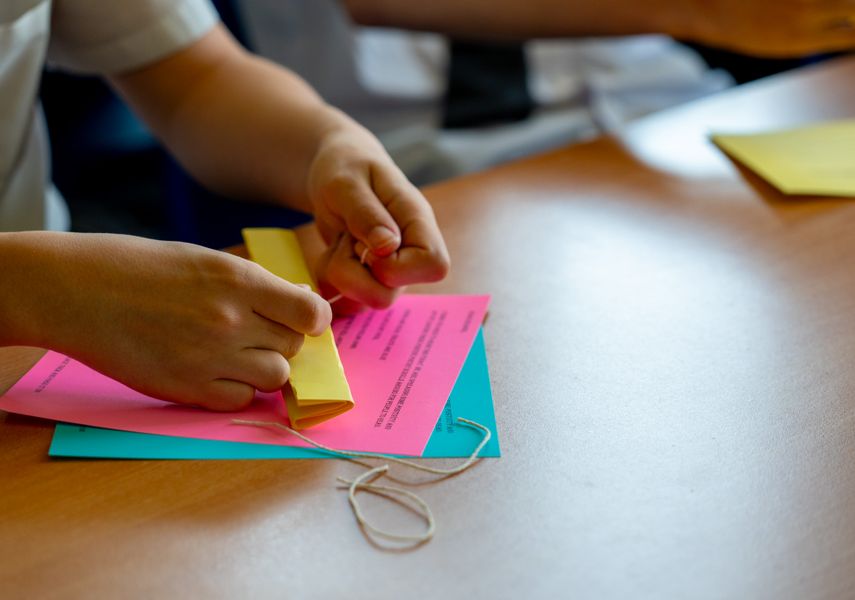
Artists in schools perhaps find themselves in a stronger position to prioritise pupil curiosity. They are often in a privileged position: their sessions are not expected to cover the curriculum and will not be examined. They can feel like they exist in a liminal time and space - not just another lesson on the school timetable and often transforming spaces for learning by pushing tables and chairs to one side, or moving into the school hall or playground. They encourage pupils to pursue their own interests through artistic practices, channelling their passions through creative writing, dance, painting, photography, and other art forms. They have time to answer pupils' questions and value even the most unusual ideas and interests they might share. They model their own creative process, marked by characteristics of curiosity: exploring areas of interest, driven by a hunger to find out more, towards creating something new.
My research attempts to capture aspects of children and young people's curiosity and understand whether we can measure it as a possible outcome of working with an artist in school. If we find artists' approaches to teaching and learning are well-placed to nurture pupils' curiosity, and we consider this to be beneficial, is this something that could be further supported in schools through collaboration between artists and teachers? Could we safeguard more time and space in schools to pursue this kind of explorative, experimental, pupil-led learning? What might a school driven by curiosity look like?
Loewenstein, G. (1994). The psychology of curiosity: A review and reinterpretation. Psychological Bulletin, 116(1), 75.
Litman, J. (2005). Curiosity and the pleasures of learning: Wanting and liking new information. Cognition and Emotion, 19(6), 793-814.
Kidd, C., & Hayden, B. Y. (2015). The psychology and neuroscience of curiosity. Neuron, 88(3), 449-460.
Le Cunff, A. L. (2024). Systematic curiosity as an integrative tool for human flourishing: A conceptual review and framework. Integrative Psychological and Behavioral Science, 58(4), 1876-1894.
Peterson, E. G. (2020). Supporting curiosity in schools and classrooms. Current Opinion in Behavioral Sciences, 35, 7-13.
Thomson, P., & Hall, C. (2019). Countering dull pedagogies: the power of teachers and artists working together. In Resisting Neoliberalism in Education (pp. 75-88). Policy Press.